

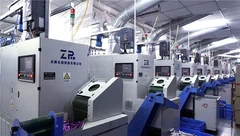
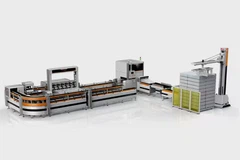

Spinning Machine Main Unit
Your Professional Spinning Machine Main Unit Supplier
We are a high-tech enterprise specializing in intelligent transformation solutions for traditional manufacturing, particularly textile machinery. We are a high-tech enterprise specializing in intelligent transformation solutions for traditional manufacturing, particularly textile machinery. Guided by the principle of "Innovation Drives Development," we are committed to advancing industrial automation and intelligence through independent R&D.


Why Choose Us
Certificate
We possess 10 national patents and 3 registered trademarks, reflecting our strong innovation capabilities and commitment to independent research and brand development. These achievements demonstrate our technical strength and enhance our competitiveness in the industry.
Advanced Equipment
Our strength lies in integrating precision mechanics with smart control. We possess 10 national patents and 3 trademarks. Our R&D is dedicated to making machinery more intelligent, energy-efficient, and reliable.
Customized Service
We ensure that you experience our professionalism, efficiency, and sincerity at every stage: pre-sales, during sales, and after-sales.We have established 24/7 service response channels.
Production Market
We have established a solid customer base, particularly in the emerging global textile industry centers of Southeast Asia and South Asia.Our globalization strategy is steadily advancing, focusing on future expansion into more markets with high potential.

High Productivity and Speed: Rotor spinning speed is 60–80,000 rpm or more, producing 1–2 times more output compared to conventional ring spinning. Modern machines can reach speeds exceeding 150,000 rpm.
Reduced Production Costs: The process skips the roving stage and directly produces large, ready-to-use cross-wound packages (cones), saving on labor, power (\(15-20\%\) lower), and space.
Superior Yarn Quality/Evenness: Rotor-spun yarn is generally more even, cleaner, and has better abrasion resistance than ring-spun yarn. It also has better dye uptake.
Superior Yarn Quality (Evenness): Rotor-spun yarns have better, more consistent evenness, fewer faults (neps/thick places), and better dye uptake.
High-Volume Production: Ideal for producing coarse to medium count yarns (e.g., denim, home textiles, knitwear) efficiently.
Improved Yarn Quality and Consistency: Automated control systems allow for precise regulation of speed and tension, ensuring uniform yarn thickness and strength.
Advanced Automation & Technology: Modern machines incorporate automated features such as computerized controls (PLCs), auto-levelers for yarn uniformity, and pneumatic pressure heads to maintain optimal, consistent quality, often in a single step.
Cost Efficiency: While initial investment exists, these machines reduce overall production costs by decreasing labor reliance, minimizing raw material waste, and lowering power consumption per kilogram of yarn.
Environmental & Energy Efficiency: New machinery is designed for lower energy consumption per unit and better fiber utilization, contributing to more sustainable manufacturing processes.

Technical Parameters
|
Parameter |
Specification |
|
Product Name |
Rotor Spinning Machine (Open-End Spinning Machine) |
|
Brand |
Zhuopeng or ZP Textile Machinery |
|
Model |
BD Series (e.g., BD-D6, BD-D7) or Custom Model |
|
Number of Rotor Positions |
120, 192, 240, 288, 360 positions (Standard configurations) |
|
Rotor Speed |
Up to 90,000 – 130,000 rpm (Model dependent, e.g., up to 120,000 rpm for BD-D7) |
|
Yarn Count Range |
Ne 3 – Ne 30 (Wide range for coarse to medium counts, e.g., 6-40s) |
|
Rotor Diameter |
Φ33mm – Φ56mm (Affects yarn count and character; e.g., Φ46mm common) |
|
Delivery Speed |
Up to 150 – 220 meters/minute |
|
Main Power Consumption |
Total ~45 – ~150 kW (Varies with number of positions, e.g., ~2.2 kW per position) |
|
Control System |
Centralized PLC with Individual Spindle Monitoring & Touch Screen HMI |
|
Machine Dimensions (L×W×H) |
Varies with positions (e.g., 240-position machine ~18000×1200×2000 mm) |
|
Net Weight |
Varies with positions (e.g., 240-position machine ~10000 – 12000 kg) |
|
Parameter |
Recommended Specifications and Notes |
|
Product Name |
Ring Spinning Frame (Cotton Spinning Machine) |
|
Brand |
Zhuopeng or ZP Textile Machinery |
|
Model |
FA506 (Classic universal model), F1516 (with automatic doffing), FA1569 (long frame), etc. |
|
Spindle Number |
516 spindles (standard long frame), 600 spindles (with collective doffing), 1200 spindles (extra-long frame); all customizable |
|
Spindle Speed |
Up to 18,000 – 22,000 rpm (specific depends on model and process) |
|
Yarn Count Range |
Ne 6 – Ne 80 (approx. 100-7.3 Tex), covering coarse to fine counts |
|
Ring Diameter |
Φ38mm – Φ45mm (common range, 38mm widely used) |
|
Main Motor Power |
45 – 75 kW (e.g., ~45-55kW for 516 spindles, ~70kW for 600+ spindles) |
|
Control System |
PLC with Frequency Conversion Drive (standard configuration) |
|
Machine Dimensions (L×W×H) |
Strongly correlated with spindle count: e.g., ~20300×700×2300 mm for 516 spindles; ~37600×1000×2300 mm for 1200 spindles |
|
Net Weight |
Strongly correlated with spindle count: e.g., ~9500 – 12000 kg for 516 spindles; ~13500 kg for 600 spindles; ~10000 kg for 1200 spindles |
Types of Rotor Spinning Machine
Fully Automated Rotor Spinning Machines
These machines manage automatic piecing (re-joining broken ends), yarn package changes, and monitoring with minimal human intervention, designed for maximum productivity.
Semi-Automated Rotor Spinning Machines
These offer manual or semi-automatic piecing, offering lower initial capital costs while maintaining high quality, suitable for specialized or smaller production runs.Small vs.
Large Rotor Diameter Machines
The diameter of the rotor affects the yarn count. Smaller rotors are used for higher speeds in finer count yarns, while larger rotors are better for coarser, heavier yarns.
Types of Cotton Spinning Machine
Ring Spinning Machines
Produces the highest-quality yarn with excellent strength and smoothness; ideal for fine-count cotton fabrics like shirts and bed linens.
Rotor (Open-End) Spinning Machines
Pros: Faster production speeds; lower labor and operational costs; good for coarser yarns used in denim, towels, and industrial materials.
Air-Jet Spinning Machines
Extremely fast; low manpower requirements; produces soft, bulky yarns with good abrasion resistance.
Friction Spinning Machines
Suitable for waste fibers and non-standard materials; highly versatile in handling short-staple cotton.
Components of Rotor Spinning Machine
Spindle:
Spindle is a hollow cylindrical tube, consists of mainly two parts (upper parts bolster) and capable to run high speed. Normally upper part of spindle is taper, which holds ring cop and bolster is fixed to the ring rail by nut. Spindle is driven by tape at the position of whorl. The diameter of whorl is important for high speed.
Lappet:
Lappet consists of thread guide and an arm. This thread guide lead the yarn centrally over the spindle axis and arm fix at lappet rail.
Ballon control ring:
Ballon control ring is a ring, which control or reduces the diameter of yarn ballon at middle position. Actually it divided the ballon into two sub-ballons. Normally yarn ballon is formed during twisting and winding of yarn at ring spinning machine.
Separator:
Separator is an aluminum or plastic plate, which is placed between the individual spindle to prevent the hurled of broken thread to neighboring yarn making ballon.
Ring:
This is the renowned ring, so for the frame is named as ring spinning frame. Most commonly carbon steel is used; but different hardened steel is also used. The ring is tough and hard. The range of its surface hardness is between 800-850 vickers. Ring diameter varies 38-54 mm.
Cleaning Process Of Rotor Spinning Machine
Loosening
Decomposing the raw material from a compact state to a relaxed state.
01
Mixing
The mixing of multiple or multicomponent ingredients evenly.
02
Decontamination
To remove impurities from raw materials as much as possible.
03
Carding
Try to separate the fibers into a single fiber state.
04
Strip
As required to be packed in strips in a tampon bucket for the next process.
05
Working Principle Of Rotor Spinning Machine
Sliver Feed
A card or draw frame sliver is fed through a sliver guide via a feed roller (f) and feed plate (B) to a rapidly rotating opening roller (o).
Sliver opening
The rotating teeth of the opening roller comb out the individual fibers from the sliver clamped between feed table and feed roller. After leaving the rotating opening roller, the fibers are fed to the fiber channel.
Fibre transport to the rotor
Centrifugal forces and a vacuum in the rotor housing causes the fibres to disengage at a certain point from the opening roller and to move via the fibre channel to the inside wall of the rotor.
Fiber collection in the rotor groove
The centrifugal forces in the rapidly rotating rotor cause the fibers to move from the conical rotor wall toward the rotor groove and be collected there to form a fiber ring.
Yarn formation
The rotor rotates at high speed creating a centrifugal force. To start spinning, a length of yarn already wound onto the package of the take-up mechanism is threaded through the nip line of the delivery rollers and into the draw-off tube .
Yarn Take-up and Winding
Once the yarn tail enters the rotor, the delivery rollers (K) are set in motion to pull the tail out of the rotor. The pulling action on the tail results in a peeling of the fiber ribbon from the rotor groove.
As one of the most professional spinning machine main unit manufacturers and suppliers in China, we also support customized service. We warmly welcome you to buy high quality spinning machine main unit made in China here from our factory. Welcome to view our website for more information.
spinning machine main unit, Multifunctional Cotton Spinning MachineMachine, High performance Cotton Spinning MachineMachine