



Video Placeholder
(A video showcasing the system's operation, from the automated guided vehicle (AGV) docking and computer vision identifying empty slots to the robotic arm precisely picking and placing bobbins into the winder magazine, can be embedded here.)
Features & Applications (FABE Framework)
F1: Vision-Guided, Flexible Robotic Handling
A (Advantage): Employs a high-precision machine vision system and a multi-axis jointed robotic arm instead of bulky traditional mechanisms. The vision system accurately locates empty magazine slots and calculates the optimal pick-up point for randomly placed bobbins in a bin, even when they are overlapping. The gripper combines clamping and suction for reliable pick-up.
B (Benefit): Eliminates the pre-step of neatly arranging bobbins, saving further labor. The system's flexibility allows it to adapt to various bobbin sizes and magazine layouts, making the retrofit process simpler and more future-proof compared to rigid mechanical systems.
E (Evidence): {Image suggestion: robotic-arm-vision-guided-bobbin-picking.jpg showing the arm in action with a highlighted vision recognition overlay on the HMI.}
F2: Integrated Process for Maximum Uptime
A (Advantage): The system is not just a loader; it prepares the bobbin for efficiency. It can be integrated with functions like tail separation, bobbin sorting by color, and automatic big-end/small-end orientation. It features self-cleaning mechanisms to reduce manual maintenance.
B (Benefit): Creates a seamless "bin-to-spindle" workflow. By presenting pre-oriented bobbins and separating waste, it minimizes downstream disruptions on the winder itself, directly contributing to higher Overall Equipment Effectiveness (OEE) and better yarn quality by reducing handling-induced defects.
E (Evidence): Installation case studies demonstrate a reduction in manual creeling labor by 1-2 operators per shift on connected winder lines.
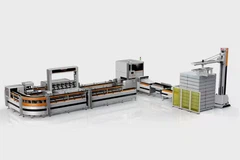
Process Flow & Product Details


Quality Assurance & Company Strength
Our system is built with industrial-grade robotics and control components designed for 24/7 operation in textile mill conditions. The core intelligence-the vision recognition and path planning algorithms-are developed based on extensive research into robotic handling in unstructured environments. Each system undergoes rigorous simulation and cycle testing before delivery to ensure reliability and seamless integration with your specific winder model.
Service & Support
We provide a comprehensive retrofit service package:
Feasibility Audit & Planning: Assess your current winder models, floor layout, and bobbin flow to design an optimal automation cell.
Turnkey Retrofit Installation: Our engineers handle the full installation, which typically requires only the removal of the old manual magazine and can be completed in approximately 1.5 days per machine. We manage mechanical fitting, electrical wiring, and software integration.
Training & Commissioning: Train your staff on system operation, basic troubleshooting, and daily maintenance.
After-sales Support: Provide a 12-month warranty, remote diagnostics, and dedicated support for spare parts and software updates.
Deliver,Shipping And Serving

Our company participate in Shanghai textile machinery exhibition every year, the brand "ZP" has been widely publicized in a variety of magazines, newspapers and networks with a wide range of visibility in the national textile industry. Since the year 2003, our products have been widely sold in China and abroad, such as Indonesia, Vietnam, Pakistan, Bangladesh, India, Thailand, etc. Gained well reputation in these local areas. Professional equipment and comprehensive after-sales service are our core strengths. Whenever customers have needs, we dispatch our most experienced engineers to their sites to resolve issues promptly.


FAQ
Q: How many years of industry experience does your company have?
A: Shanghai Zhuopeng Technology & Machinery Co., Ltd. is a professional company with 23 years of profound industry expertise (since 2002). These 23 years represent not only the passage of time, but also the depth of our practical experience, having served over 360 clients and completed more than 50 major projects. We deeply understand the pivotal role of electromechanical automation systems in industrial production. Therefore, we are committed to integrating time-tested reliability with cutting-edge energy-saving and automation technologies, delivering stable and future-oriented solutions to our clients. This commitment is precisely what sets us apart from mere product suppliers.
Q: What are the main products of your company?
A: The company's main products include slubby yarn devices, various types of core-spun yarn devices, Siro Spinning, Ultra-Soft yarn devices, and more.
Q: How to select the appropriate modification device for my factory?
A: The customer needs to provide the model and spindle count data of the spinning frame to be modified.
Q: What are the core advantages of your company's devices compared to other similar products on the market?
A: The core advantages of our products lie in their highly integrated mechatronic design and fully digital intelligent control system, which enable precise operation and efficient management. By addressing key user pain points, our solutions deliver an excellent return on investment. The products support remote real-time monitoring and maintenance, offering a worry-free and highly efficient experience. Combined with user-friendly interactive design, they significantly enhance production efficiency while achieving remarkable energy-saving and consumption-reduction goals-ultimately creating intelligent and sustainable core value for our clients.
Q: What are the payment terms and delivery lead time?
A: Our company adopts a payment method of advance T/T and, through effective management, precisely controls the delivery cycle to ensure timely delivery according to customer requirements.
Q: Do you provide on-site installation services? What are the standard installation duration and associated costs?
A: Since our products are all mechatronic systems that carry production processes, the core of equipment delivery shifts from physical installation to process deployment and capability transfer. The end goal is to ensure that customers can independently and stably operate the equipment to produce qualified products. Personnel training and empowerment (knowledge transfer) are key, guaranteeing that users can independently and stably utilize the equipment to manufacture compliant products.
Q: Installation duration and costs?
A: The installation duration is generally determined based on the number of units purchased and will be specified in the contract.
Installation costs include round-trip airfare, accommodation and meals during the installation period, and a daily allowance of USD 70 per person.
Q: What is the warranty period, and what does the warranty coverage include?
A: The warranty period is one year.
Warranty coverage includes: hardware warranty, software maintenance and upgrade services, annual on-site inspection and maintenance, and other related services.
Issues caused by site conditions under the customer's responsibility (such as unstable power supply or environmental temperature/humidity exceeding standards) are not covered by the warranty.
Warranty service is not only about fixing faults but also includes training support. After each service, a signed service report will be provided, documenting the cause of the issue, the actions taken, and recommendations for subsequent operations.
Q: How to order original spare parts and consumables?
A: ① For original spare parts:
Bundled procurement with main equipment: When purchasing the main equipment, negotiate the inclusion of key, specialized original spare parts required for the coming years as part of the contract or as optional attachments. This often results in better pricing and technical assurance.
② Adopt the "supply agreement" model:
For more universal spare parts, a "supply agreement" can be utilized. This involves selecting a supplier and agreeing on pricing through a one-time bidding process, allowing for direct procurement as needed during the agreement period. This approach balances efficiency with economies of scale.
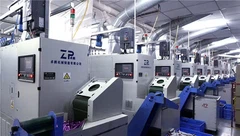
Overview of factories and office buildings


Technical Parameters
| Parameter | Specification |
| Product Name | Automatic Bobbin Feeding System for Magazine Winding Machines |
| Brand / Model | Zhuopeng / ZP-ABF100 |
| Applicable Winder Type | Various models of magazine-type automatic winders (Retrofit solution) |
| Feeding Method | Robotic Arm with Adaptive Gripper & Suction Cup |
| Bobbin Recognition | Machine Vision System (Identifies empty slots & bobbin pick-up points) |
| Compatible Bobbin Types | Standard ring spinning tubes (Plastic/Paper), supports color-coded tubes |
| Simultaneous Varieties | Capable of handling 2 different yarn counts/varieties concurrently |
| System Efficiency | Central processor bobbin finding efficiency > 90%; Re-finding rate at winding spindle > 99% |
| Navigation | Magnetic tape guidance or LiDAR navigation options |
| Power Requirements | 220V/380V, 50/60Hz, Total Power: ~3.5 kW |
| System Dimensions (L×W×H) | Mobile Unit: Approx. 1600×800×1500 mm (Compact footprint) |